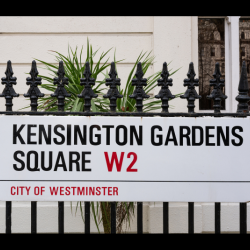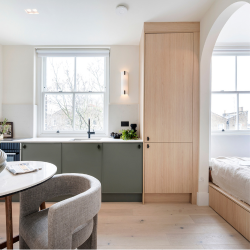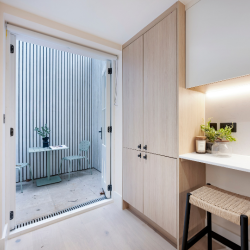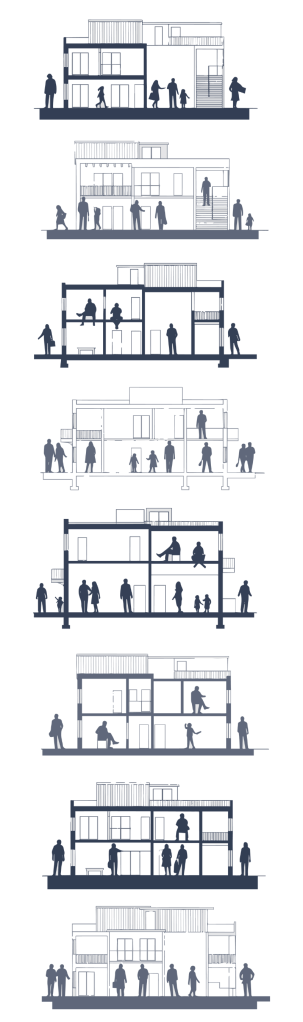



Within the refined setting of Kensington Gardens Square, this recent HRA Architects project has transformed a Grade II listed building into 31 residential units and co-living spaces designed for students and young professionals.
Appointed by Leufroy, a London-based real estate investment specialist, HRA Architects delivered the scheme from post-planning through to completion. The brief called for a sensitive approach – retaining the building’s historic identity while introducing the standards expected of modern living. The finished development offers a carefully curated co-living environment that bridges heritage and contemporary use.
Revealing the Building’s Original Character
Previously arranged as a House of Multiple Occupation (HMO), the internal layout had become increasingly disjointed. Over time, a series of poorly considered alterations had compromised both the proportions and character of the spaces. Period features were concealed with cornicing hidden above lowered ceilings, fireplaces enclosed, and the clarity of the original rooms was greatly diminished.
Our approach focused on reversing these changes. By stripping away later additions, we were able to expose and reinstate the building’s historic fabric, restoring a sense of proportion and spatial coherence.
Working Within a Complex Framework
Operating within the constraints of HMO regulations, listed building status, and conservation area requirements, the scheme required a strategic rethinking of the internal arrangement. Floor plates across five levels were reorganised to support a functional and cohesive co-living model.
This project offered a rare opportunity to focus on design with relatively few complications during construction. We were able to turn the constraints of the existing layout into an advantage – using carefully considered insertions to deliver modern living standards while preserving the building’s character.
Justin Harper-Ronald, Director
Restoring Architectural Detail
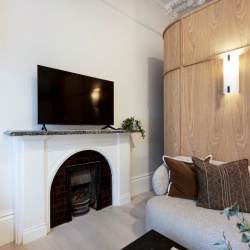
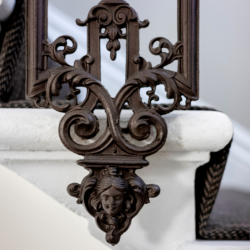
A key priority was the reinstatement of original features that define the building’s identity. Decorative cornices, fireplaces, and the central staircase were all carefully restored, while existing stonework was repaired and conserved.
These elements now play a central role in the experience of the space, reintroducing the scale, craftsmanship, and proportions intended in the building’s original design.
Introducing a Contemporary Layer
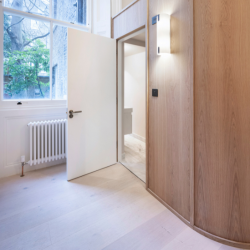
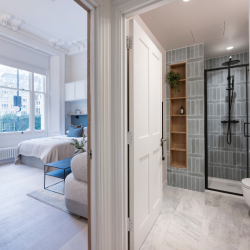
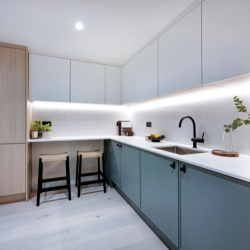
While restoration was fundamental, certain interventions were necessary to support the building’s new function. Kitchens, ensuites, and bathroom pods were incorporated as modern additions.
Rather than attempting to blend these elements invisibly, they were intentionally expressed as contemporary insertions. Through the use of contrasting materials and detailing, a clear distinction is drawn between historic fabric and new interventions – creating a layered architectural narrative.
Bathroom pods were conceived as independent volumes within rooms. Where spatial limitations prevented bathrooms within smaller units, pods were positioned within neighbouring larger spaces to serve multiple studios. This solution enabled the scheme to meet current expectations for amenity while respecting the constraints of the existing structure.
A Reimagined Living Environment
32–33 Kensington Gardens Square now stands as a unified and thoughtfully executed co-living development. The project illustrates how considered architectural intervention can successfully align heritage conservation with present-day housing needs.
The result is a collection of compact, high-quality homes that celebrate the building’s history while supporting a new generation of residents.